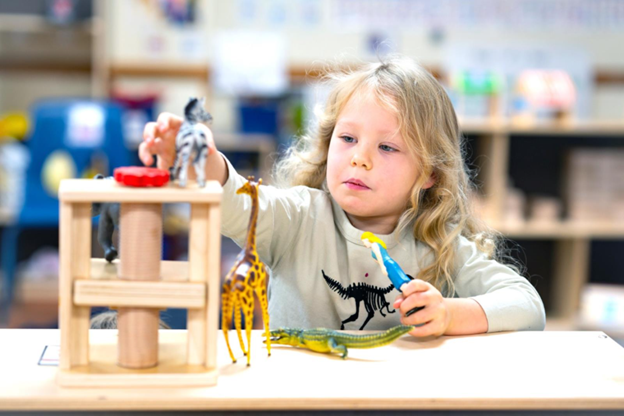
At MECK Pre-K, children learn best by doing. That’s why hands-on learning is at the center of each day — from exploring materials during center time to asking questions, creating, building, and discovering alongside classmates and teachers.
MECK Pre-K uses a research-based, project-based approach that supports learning through active exploration and meaningful experiences. Rather than focusing on worksheets or rote memorization, children engage directly with ideas, materials, and their environment — helping learning feel real, relevant, and exciting.
Learning Through Play and Purposeful Centers
Hands-on learning at MECK Pre-K often happens during center time, when children choose activities that spark their interests. Classrooms are intentionally designed with learning centers — such as dramatic play, art, blocks, science, and literacy — where children can explore materials, solve problems, and collaborate with peers.
Through these experiences, teachers guide learning by observing, asking questions, and extending children’s thinking, helping them make connections while staying engaged.
As one parent shared, “He talks about what he learned at school. He loves center time.” Another parent noticed how much joy comes from these daily experiences, saying, “She talks about funny things that happened throughout the day. Her favorite classroom activities are dramatic play and art.”
These moments reflect how hands-on learning supports curiosity, creativity, and meaningful engagement.
Creative Expression as Hands-On Learning
Music and art play an important role in hands-on learning at MECK Pre-K. When children paint, draw, sing, move, or explore musical instruments, they are strengthening fine motor skills, communication, and self-expression — all while learning through active participation.
Creative experiences allow children to experiment, make choices, and express ideas in their own ways, helping learning feel personal and empowering.
One parent shared, “They enjoy the crafts that they get to make during the day.”
These creative moments are more than just fun — they support learning across many areas while giving children opportunities to explore materials and express themselves.
Math and Science Through Exploration
Math and science concepts come to life through hands-on discovery. Children work with real objects to count, compare, measure, observe, and experiment. These experiences help them develop problem-solving skills and an early understanding of how the world works.
By exploring materials and investigating questions together, children practice skills like predicting, observing, and describing — all essential parts of scientific thinking and early math development.
A parent described how these lessons extend beyond the classroom: “My child tells me all about the fun lessons they learn about and how it helps him learn to recognize things in the community such as letters, signs, stores etc.”
Hands-on learning helps children connect what they learn at school to the world around them.
Building Language and Confidence Through Daily Experiences
Language and literacy development are woven throughout the day through hands-on activities and interactions. Children build vocabulary by talking with teachers and peers, exploring books, and sharing ideas during play and group activities.
Because learning is active and social, children naturally practice communication — describing what they’re doing, asking questions, and telling stories about their experiences.
As one parent noted, “He talks about what he learned at school.”
These everyday conversations help build confidence and support children as they learn to express themselves.
Social-Emotional Growth Through Connection
Hands-on learning also supports social-emotional development. Through shared experiences, children learn how to cooperate, problem-solve, and build relationships with others.
Parents often see how important these connections become. One shared, “My son likes to talk about his friends.” Another added, “He talks about everyone but his best friend he says is Angel.”
These relationships help children feel a sense of belonging and build the skills they need to navigate social situations in school and beyond.
At MECK Pre-K, hands-on learning is more than an approach — it’s how children experience their day. Through purposeful play, exploration, creativity, and connection, children learn in ways that are engaging, meaningful, and designed to support their growth across all areas of development.
About MECK Pre-K
MECK Pre-K is a high-quality pre-K program open to all four-year-old children in Mecklenburg County at no cost to families. Classrooms are located in licensed childcare centers and taught by licensed teachers and highly qualified assistant teachers. You can apply online at MeckPreK.org.
Do you have a child who is not old enough for pre-K this year? Sign up for our email list and be notified when they’re eligible for MECK Pre-K. Simply go to MECKPrek.org/future-meck-pre-k-students and select your child’s age group.