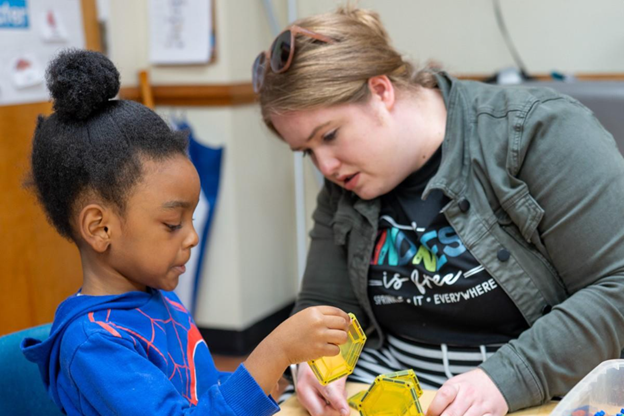
Walk into a MECK Pre-K classroom and you’ll notice it right away: children deeply engaged in play, conversation, and exploration while teachers move easily among them, listening, guiding, and responding in real time. That sense of calm, connection, and purpose isn’t accidental.
In fact, small class sizes in pre-K play an important role in creating an environment where every child receives the attention and support they need to thrive.
At MECK Pre-K, classrooms are designed to support meaningful learning by maintaining a 9:1 student-to-teacher ratio. This structure allows teachers to truly know each child—and that makes a powerful difference during these formative years.
More Time for Meaningful Connections
Young children learn best through relationships. When class sizes are smaller, teachers have more opportunities to build strong, trusting connections with each child. They can notice subtle cues, respond to individual needs, and support children as they develop confidence and independence. These relationships reflect the qualities of a great pre-K teacher and help children feel safe, valued, and supported.
As one MECK Pre-K teacher puts it:
“One morning routine that sets a positive tone in our classroom is our daily greetings. Each child is welcomed by name with a smile, eye contact, and a choice of greeting, which helps them feel seen, valued, and ready to start the day in a positive way.”
This thoughtful approach helps children feel safe to:
- Ask questions
- Try new things
- Work through challenges
- Express emotions
When children feel seen and supported, they are more willing to engage—and learning naturally follows.
Personalized Support, Every Day
Every child arrives at pre-K with their own strengths, interests, and areas for growth. Small class sizes allow teachers to tailor instruction in ways that simply aren’t possible in more crowded environments.
In a MECK Pre-K classroom, teachers can:
- Adjust activities to meet children where they are developmentally
- Offer extra guidance when a child is struggling
- Extend learning for children who are ready for a new challenge
This individualized attention supports growth across all areas of development—from early literacy and problem-solving to social-emotional skills and self-regulation. Hands-on learning experiences further encourage children to explore, discover, and apply new skills in meaningful ways. Parents tell us how the teachers work hard to build relationships—not only with the children, but with their families.
“My child’s teacher came in ready to win the children over, and she continues to provide updates in a very thorough manner.”
Stronger Peer Learning and Collaboration
Smaller groups don’t just benefit teacher-child relationships—they also strengthen peer interactions. With fewer children in the classroom, teachers can more easily facilitate collaboration, encourage turn-taking, and help children learn how to listen to and learn from one another.
Children practice:
- Sharing ideas during play
- Working together to solve problems
- Communicating clearly with peers
- Navigating social situations with guidance and support
These experiences help build skills that are essential for kindergarten—and for life beyond the classroom.
A Classroom That Feels Calm, Engaging, and Joyful
Small class sizes contribute to a learning environment that feels purposeful rather than overwhelming. Teachers can maintain predictable routines, support smooth transitions, and create spaces where children can focus, explore, and play.
The result is a classroom with a joyful buzz—full of curiosity, conversation, and discovery—where learning feels engaging and developmentally appropriate.
Small Class Sizes Support How Young Children Learn
At MECK Pre-K, small class sizes work hand in hand with a research-based hands-on learning curriculum designed specifically for how young children learn. Teachers use observation, play, and intentional instruction to help children build strong foundations—academically, socially, and emotionally.
These early experiences don’t just prepare children for kindergarten. They help set the stage for a lifetime of learning.
You’ll Be Amazed by the Difference
Families often tell us they’re amazed by how much their children grow during their time in MECK Pre-K—how excited they are to come to school, how confidently they share what they’ve learned, and how learning continues even after the school day ends. Small class sizes are one of the reasons why. As one MECK Pre-K parent put it:
“My child absolutely looks forward to going to school every morning! They love getting to be with their friends and adore all their teachers.”
Frequently Asked Questions
Why are small class sizes important in pre-K?
Small class sizes allow teachers to spend more one-on-one time with each child, provide individualized support, and build stronger relationships. This helps children grow academically, socially, emotionally, and prepare for kindergarten.
What is the student-to-teacher ratio at MECK Pre-K?
MECK Pre-K classrooms maintain a 9:1 student-to-teacher ratio, allowing teachers to provide personalized attention while creating a safe, engaging learning environment.
How do small class sizes support learning?
Small class sizes help teachers tailor instruction to each child’s needs, encourage meaningful participation, and create more opportunities for collaboration and individualized support.
How does MECK Pre-K support children’s learning?
MECK Pre-K combines small class sizes, hands-on learning, and experienced teachers to create nurturing classrooms where children develop the confidence and skills they need for kindergarten and beyond.
About MECK Pre-K
MECK Pre-K is a high-quality pre-K program open to all four-year-old children in Mecklenburg County at no cost to families. Classrooms are located in licensed childcare centers and taught by licensed teachers and highly qualified assistant teachers. You can apply online at MeckPreK.org.
Do you have a child who is not old enough for pre-K this year? Sign up for our email list and be notified when they’re eligible for MECK Pre-K. Simply go to MECKPrek.org/future-meck-pre-k-students and select your child’s age group.